 Mason Calculator
We’ve all been there: standing at the gas pump in the middle of a long commute or a family road trip, watching the dollars climb higher and higher on the digital display. In an era where fuel prices feel like a rollercoaster, understanding exactly how much distance you’re getting for every dollar spent isn’t just a matter of curiosity it’s a financial necessity.
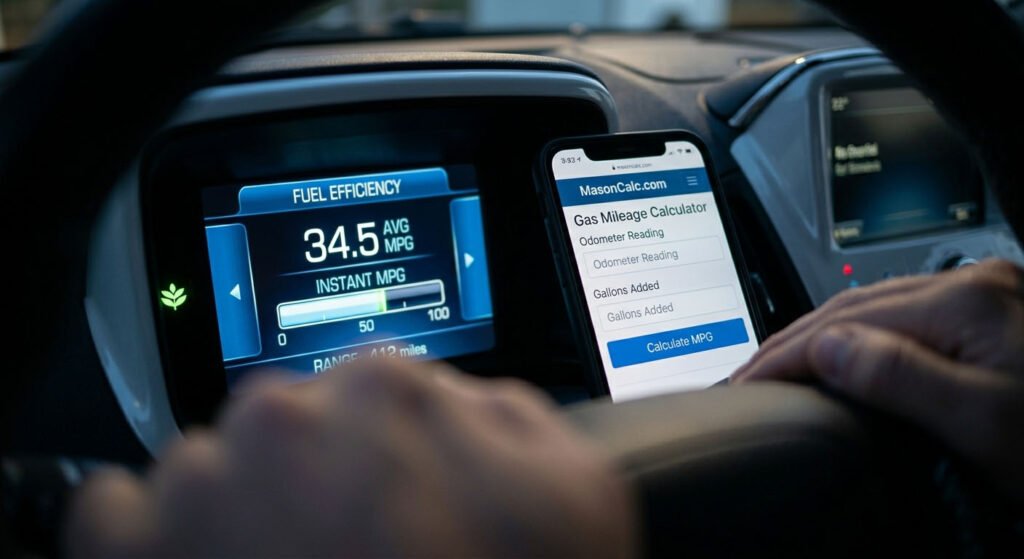
What Exactly is Gas Mileage (MPG)?
Gas mileage, commonly referred to as MPG (Miles Per Gallon) in the United States, is the measure of how many miles a vehicle can travel on a single gallon of fuel. It is the gold standard for measuring vehicle efficiency. A higher MPG means your car is more efficient, using less fuel to travel the same distance, which ultimately leaves more money in your pocket and reduces your carbon footprint.
How a Gas Mileage Calculator Works
Calculating your gas mileage manually can be tedious and prone to math errors. That is where a Gas Mileage Calculator comes in. These tools are designed to take the guesswork out of the equation.
The logic behind the calculator is a simple but powerful mathematical formula: The Formula: (Ending Odometer Reading – Starting Odometer Reading) / Gallons Used = MPG
Steps to Calculate Manually (and How the Tool Does it Faster):
- The Fill-Up: Fill your tank completely and record your current mileage (the “Starting Odometer”).
- The Drive: Go about your normal routine until you need gas again.
- The Refill: Fill the tank again and note two things: the number of gallons it took to fill it and your new mileage (the “Ending Odometer”).
- The Calculation: Subtract the start mileage from the end mileage to find the total miles driven. Divide that number by the gallons you just pumped.
[IMAGE 2 PLACEMENT: Below the calculation steps to show the ease of using a mobile tool while at the station.]
- Image Meta Detail:
- Alt Text: A driver using a smartphone to calculate gas mileage while refueling an SUV at a sunny gas station.
- Title: Real-time Fuel Tracking with MasonCalc.
Real-World Examples of Gas Mileage in Action
Example 1: The Commuter’s Savings Imagine Sarah, who drives a mid-sized sedan. She fills up her tank and her odometer reads 45,000. After a week of driving to work, she refills. Her odometer now reads 45,350, and she pumped 10 gallons of gas. (350 miles / 10 gallons = 35 MPG). By using the Gas Mileage Calculator, Sarah realizes her car is performing at its peak. If that number suddenly dropped to 28 MPG next week, she’d know it was time for a tune-up or a tire pressure check.
Example 2: The Family Road Trip The Miller family is driving from New York to Florida in an SUV. They want to budget for fuel. They know their SUV gets about 20 MPG. If the trip is 1,200 miles, the calculator tells them they’ll need roughly 60 gallons of gas. At $3.50 a gallon, they can accurately budget $210 for the trip’s fuel costs.
Why You Should Track Your MPG Regularly
- Early Warning System: A sudden drop in gas mileage is often the first sign of mechanical issues, such as faulty spark plugs, clogged air filters, or dragging brakes.
- Better Driving Habits: Tracking your MPG helps you see how aggressive driving or excessive idling eats into your budget.
- Financial Planning: With accurate data from the Gas Mileage Calculator, you can predict your monthly expenses with precision.
Conclusion
Keeping a close eye on your fuel consumption doesn’t have to be a chore. By using a dedicated tool like the one at MasonCalc, you turn a complex task into a two-second entry. Start tracking today, drive smarter, and keep your hard-earned money where it belongs in your wallet.