 Mason Calculator
Energy is the invisible thread that connects everything in our lives. From the calories in your morning breakfast burrito to the kilowatt-hours (kWh) powering your home office, energy is constantly changing forms. However, because different industries use different units of measurement, trying to compare your electric bill to your workout routine can feel like translating a foreign language.
Understanding these units isn’t just for physicists—it’s for anyone looking to optimize their home efficiency, track their fitness accurately, or complete a school project with precision.
Common Energy Units You Use Every Day
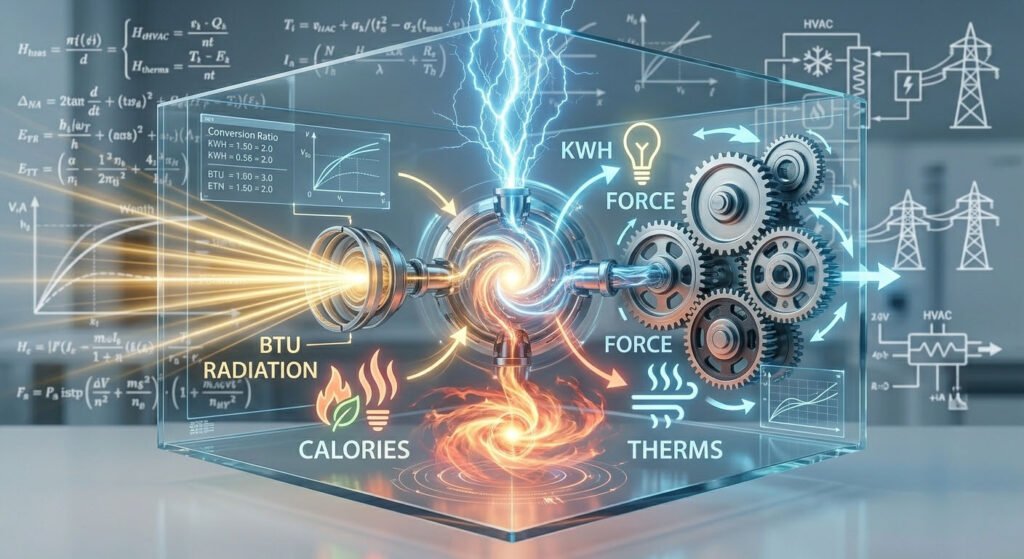
In the United States, we encounter several different “labels” for energy. Here are the most common ones you’ll need to convert:
- Joules (J): The standard unit of energy in the scientific community.
- Calories (cal): Often used to measure thermal energy or the energy content in food (though food “Calories” are actually kilocalories).
- Watt-hours (Wh) & Kilowatt-hours (kWh): The standard for measuring electrical energy consumption on your utility bill.
- British Thermal Units (BTU): Commonly used in the US for heating and air conditioning (HVAC) systems.
- Foot-Pounds (ft-lb): A unit of work or energy common in American engineering and automotive contexts.
How the Energy Converter Works
Navigating the math between these units can be daunting. For example, did you know that 1 kWh is equivalent to a staggering 3,600,000 Joules? Manually calculating these shifts is prone to “decimal point errors” that can ruin a project or a budget.
The Energy Converter acts as a universal translator. It uses fixed physical constants to instantly swap values between units.
How to use it:
- Enter your value: Type the number you want to convert.
- Select the “From” unit: Choose the unit you currently have (e.g., Calories).
- Select the “To” unit: Choose your target unit (e.g., Joules).
- Instant Result: The calculator provides the precise conversion based on international scientific standards.

Real-World Examples of Energy Conversion
Example 1: Fitness and Food
You just finished a workout that burned 500 Calories. You want to know how much raw physical work that is in Joules for a science report.
- Conversion: 1 Calorie ≈ 4,184 Joules.
- Result: Your 500-calorie workout equals roughly 2,092,000 Joules. That’s a lot of potential energy!
Example 2: Home Appliance Efficiency
You are looking at a portable space heater rated at 5,000 BTUs, but you want to know how much it will add to your electric bill in kilowatt-hours (kWh) if run for an hour.
- Conversion: 1 BTU ≈ 0.000293 kWh.
- Result: 5,000 BTUs is approximately 1.46 kWh. If your local electricity rate is 15 cents per kWh, you now know that heater costs about 22 cents per hour to run.
Why Accuracy Matters for Your Wallet and Environment
In the US, energy costs are rising. By using an energy converter, you can demystify your power usage. Whether you are converting solar panel output from Watts to Joules or calculating the cooling power of a new AC unit, having the right numbers allows you to make “green” choices that also save you greenbacks.
The next time you’re faced with a confusing energy label, don’t guess. Use the Energy Converter at MasonCalc to get the facts in seconds.