 Mason Calculator
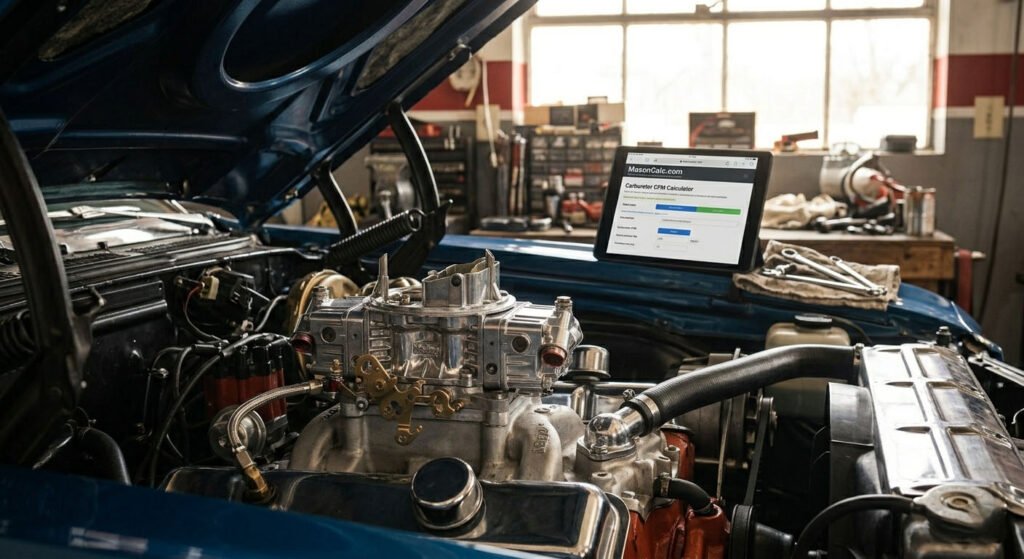
Choosing the right carburetor is one of the most critical decisions you’ll make for your engine’s performance. Pick one that’s too small, and your engine will gasp for air at high RPMs. Pick one that’s too large, and you’ll suffer from sluggish throttle response, poor fuel economy, and a “bogging” sensation that makes driving a chore.
This guide breaks down the science of Cubic Feet per Minute (CFM) and shows you exactly how to use a Carburetor CFM Calculator to get your build running perfectly.
What is Carburetor CFM?
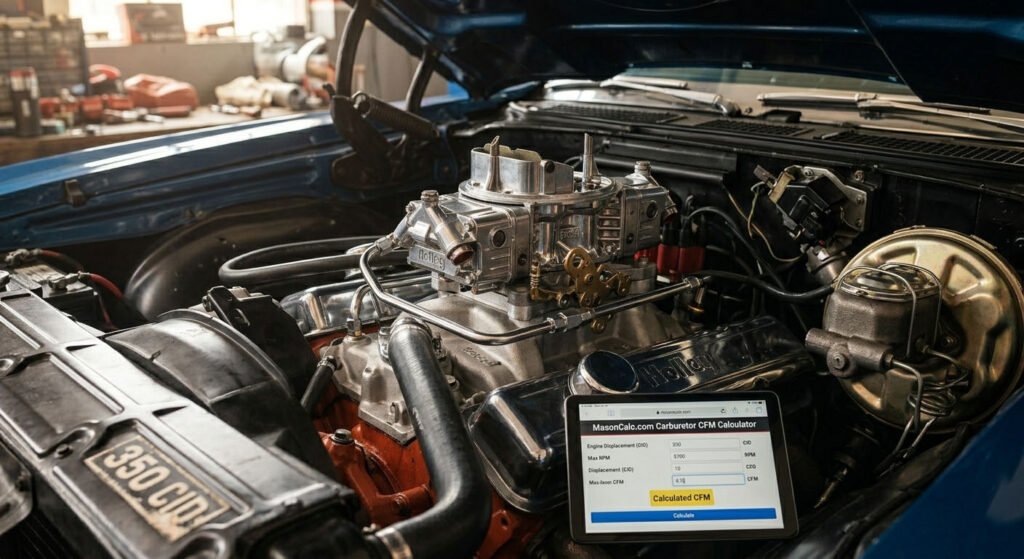
CFM stands for Cubic Feet per Minute. It is a measurement of airflow volume. In the context of an internal combustion engine, it represents how much air the carburetor can flow into the intake manifold.
Think of your engine as a large air pump. It pulls air in, mixes it with fuel, ignites it, and pushes it out. The carburetor acts as the gatekeeper. To find the “sweet spot,” you need to match the carburetor’s flow capacity to the engine’s displacement and its maximum operating speed (RPM).
The Science: How CFM is Calculated
To calculate the required CFM, engineers and mechanics use a standard formula based on the engine’s theoretical maximum air intake.
The Formula:
CFM = (Cubic Inches × Max RPM × Volumetric Efficiency) / 3,456
Breaking Down the Variables:
- Engine Displacement (CID): This is the size of your engine in cubic inches (e.g., a 350 Chevy or a 302 Ford).
- Maximum RPM: This isn’t the redline on your tachometer; it’s the highest RPM you actually plan to shift at during spirited driving.
- Volumetric Efficiency (VE): This is a percentage representing how well the engine fills its cylinders with air.
- Stock Engines: 75% – 80% VE
- Street Performance: 80% – 85% VE
- Racing/High-Performance: 90% – 100%+ VE (Turbocharged or supercharged engines can exceed 100%).
How the Carburetor CFM Calculator Works
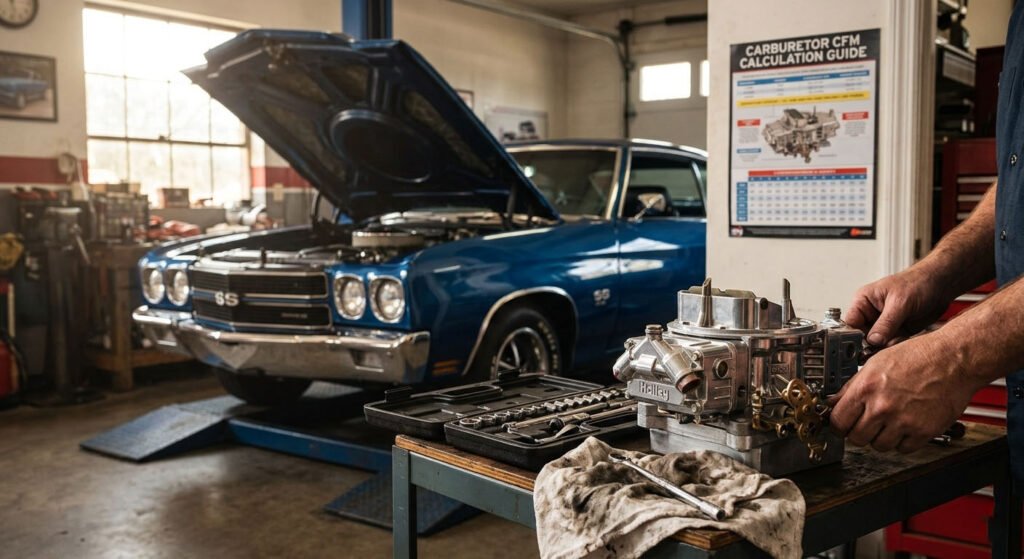
While the math isn’t impossible, the Carburetor CFM Calculator simplifies the process and eliminates human error. Here is how you use it:
- Input Displacement: Enter your engine size in cubic inches.
- Input Max RPM: Be realistic. If it’s a daily driver, 5,500 RPM is a common ceiling.
- Select VE: Choose the percentage that best describes your build.
- Calculate: The tool will provide the ideal CFM rating for your specific setup.
Real-World Examples
To give you an idea of how these numbers shift based on the build, let’s look at two classic American scenarios:
Example 1: The “Street Cruiser” (Small Block 350)
Imagine you have a classic 350 cubic inch V8. It’s mostly stock with an upgraded intake and exhaust. You rarely take it above 5,000 RPM.
- Displacement: 350
- RPM: 5,000
- VE: 80% (Standard Street)
- Result: The calculator suggests roughly 405 CFM.
- Pro Tip: In this case, a 500 or 600 CFM carb is plenty. Going to a 750 CFM would actually hurt your low-end torque.
Example 2: The “Weekend Warrior” (Big Block 454)
You have a 454 cubic inch engine built for the drag strip. You’ve got a high-lift cam, ported heads, and you’re shifting at 6,500 RPM.
- Displacement: 454
- RPM: 6,500
- VE: 90% (High Performance)
- Result: The calculator suggests roughly 768 CFM.
- Pro Tip: For this build, an 800 or 850 CFM double-pumper would be the ideal choice to ensure the engine isn’t restricted at high speeds.