 Mason Calculator
If you are planning a renovation, you are essentially a manager of “Surface Area.” Whether you are calculating how many gallons of primer to buy, how many boxes of subway tile to order, or how much a contractor should be charging you, it all boils down to one number: the total square footage (or meters) of your walls.
Measuring a flat, rectangular wall is easy. But real rooms have alcoves, sloped ceilings, windows, and doors that complicate the picture.
Thinking in 2D: The Basic Logic
At its simplest, wall area is Length x Height. But to be truly accurate, you must think of your room as a “skin” that you are unfolding.
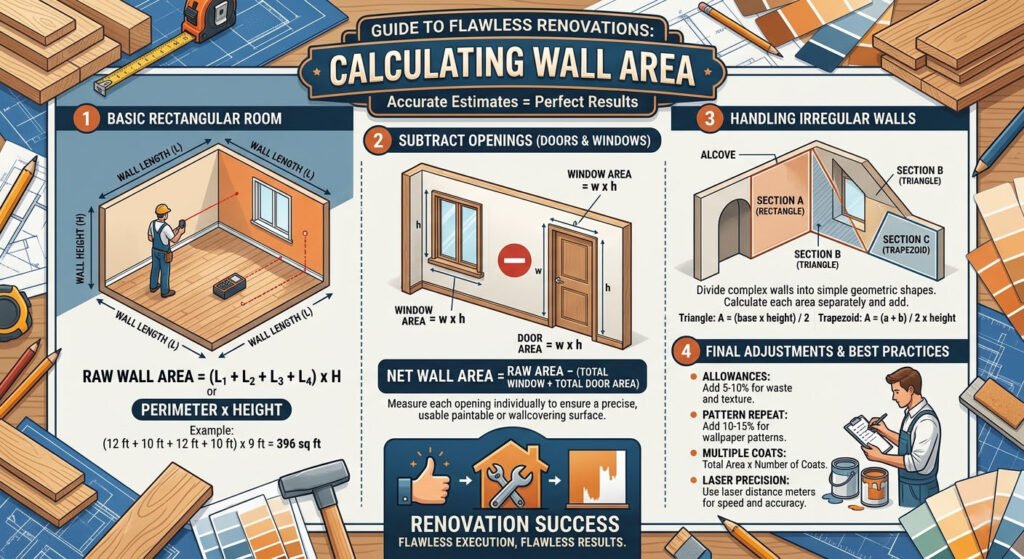
- The Subtracting Rule: You don’t paint your windows, and you don’t tile over your doors. To get the “Net Area,” you must calculate the area of these openings and subtract them from your total wall area.
Handling Irregular Spaces
Many modern homes feature “vaulted” or “cathedral” ceilings where one side of the wall is higher than the other. To calculate this:
- Measure the area of the rectangle part (the lowest height x width).
- Calculate the triangle at the top (Width x height of the slope / 2).
- Add them together.
If that sounds like a headache, don’t worry. Our Wall Area Calculator handles complex shapes and subtractions automatically.
Why “Area” Matters More Than “Floor Space”
Many homeowners make the mistake of using their floor’s square footage to buy wall materials. This is a recipe for disaster. A small bathroom with high ceilings has significantly more wall area than a large living room with low ceilings. Always measure the vertical surface specifically for the task at hand.
The “Texture Factor”
One thing a calculator can’t see is the texture of your wall. If you are painting a rough brick wall or a heavily textured “popcorn” surface, you will need 20-30% more material than the square footage suggests. The “nooks and crannies” of the texture effectively increase the surface area that needs to be covered.
Conclusion: Measurement is the Foundation of Budgeting
A successful DIY project starts with an accurate budget, and a budget starts with an accurate area count. Don’t guess and end up with three extra trips to the hardware store.
Use our Wall Area Calculator today to get your numbers right the first time, ensuring your project stays on schedule and under budget.